





Spotlights
Aerospace Technician, Aerospace Engineering Technician, Aircraft Systems Technician, Spacecraft Systems Technician, Flight Test Technician, Aerospace Manufacturing Technician, Avionics Test Technician, Aerospace Quality Inspector, Wind Tunnel Test Technician, Satellite Assembly Technician, Aerospace Operations Technician, Launch Support Technician
Every rocket that lights up the night sky, every jetliner that lifts off the runway, and every satellite silently orbiting overhead had to prove, piece by piece, that it would actually work before anyone trusted it with a flight. Aerospace Engineering & Operations Technicians are the ones who build those pieces, push them to their limits in a lab, and catch the flaws before they ever leave the ground.
Working side by side with aerospace engineers, technicians build and assemble prototype aircraft, spacecraft, and satellite hardware, then put it through its paces. They run wind tunnel tests to measure how air flows over a new wing shape, mount sensors on a test article to see how it holds up under vibration or extreme temperature, and inspect finished parts against exacting engineering drawings. When something does not perform the way the design predicted, technicians are often the first to notice, and they work with engineers, machinists, and quality inspectors to figure out why.
Using CAD software, precision measurement tools, data acquisition systems, wind tunnels, and non-destructive testing equipment like ultrasonic and X-ray scanners, these technicians turn engineering theory into flight-proven hardware. Their careful, exacting work is what allows pilots to trust their instruments, astronauts to trust their spacecraft, and millions of passengers to trust that the plane they board was tested and verified long before they ever stepped aboard.
- Seeing a design you helped test actually lift off the ground or launch into orbit
- Working at the cutting edge of flight, space, and defense technology
- Knowing your precision testing keeps pilots, astronauts, and passengers safe
- Being part of historic firsts, from new aircraft models to new rockets and satellites
Working Schedule
Most Aerospace Engineering & Operations Technicians work full-time, around 40 hours a week, though test schedules, launch windows, and production deadlines can require early mornings, evenings, or weekend shifts. The work is split between a lab or office where technicians prepare test plans and review data, and a hangar, wind tunnel, test facility, or launch site where the hands-on work happens. Some travel to customer sites, airfields, or launch facilities to support flight tests or installations. Most technicians are employed directly by aerospace manufacturers, defense contractors, or government agencies such as NASA, while a smaller number work for testing labs or engineering firms.
Typical Duties
- Building and assembling prototype aircraft, spacecraft, and satellite components
- Setting up and running wind tunnel tests to measure aerodynamic performance
- Installing sensors, instrumentation, and data acquisition systems on test articles
- Operating and monitoring equipment during structural, vibration, and thermal testing
- Inspecting parts and assemblies for conformance to engineering drawings and specifications
- Performing non-destructive testing such as ultrasonic or X-ray inspection on critical parts
- Recording, analyzing, and reporting test data to engineers
- Assisting with flight test preparation and supporting test flights or launch operations
- Troubleshooting mechanical, electrical, and systems failures during testing
- Maintaining calibration records for test and measurement equipment
- Reviewing technical drawings, blueprints, and specifications for accuracy
- Documenting test procedures, results, and non-conformance reports
Additional Responsibilities
- Coordinating with suppliers and vendors on parts and materials
- Supporting root cause investigations for test failures or in-service issues
- Maintaining test labs, wind tunnels, and fabrication equipment
- Assisting engineers with design reviews and configuration changes
- Ensuring compliance with FAA, NASA, or military testing standards
- Training junior technicians on test procedures and equipment
- Updating technical documentation and maintenance manuals
- Participating in safety audits and hazard assessments
An Aerospace Engineering & Operations Technician's morning often starts with a review of the day's test schedule and a check of instrumentation calibration on the test article. They might prep a wing section for a wind tunnel run, mount strain gauges on a bracket, or inspect a freshly machined part against its drawing before it goes any further in the build process.
Midday is often spent in the test lab, wind tunnel, or on the shop floor. The technician runs the test, whether that means cycling a landing gear thousands of times, spinning up the wind tunnel to measure lift and drag, or vibrating a satellite component to simulate a rocket launch. They watch the data stream in, note anything unusual, and pause to adjust the setup if something looks off.
In the afternoon, the technician compiles the data into a report, meets with engineers to walk through the results, and helps plan the next round of testing. They might also support a flight test crew, join a design review, or spend time documenting a new test procedure so the next technician can repeat it exactly. Before heading out, they log equipment usage and make sure the lab is ready for tomorrow.
Soft Skills
- Attention to detail
- Curiosity about how systems work
- Clear written and verbal communication
- Problem-solving and troubleshooting mindset
- Patience when tests do not go as planned
- Teamwork with engineers, machinists, and inspectors
- Adaptability to new tools and changing schedules
- Strong safety awareness
- Organization and thorough record keeping
- Calm, steady focus under pressure
- Initiative and willingness to ask questions
- Hands-on dexterity and mechanical aptitude
Technical Skills
- CAD software such as CATIA, SolidWorks, or NX
- Reading and interpreting engineering drawings and GD&T
- Precision measurement tools like calipers, micrometers, and CMMs
- Instrumentation and data acquisition systems
- Wind tunnel and structural test methods
- Non-destructive testing techniques such as ultrasonic and X-ray inspection
- Applied statistics and data analysis
- Knowledge of aerospace materials, including composites and alloys
- Basic avionics and electrical systems knowledge
- Familiarity with FAA, NASA, or military testing standards
- Wind Tunnel Test Technician: Sets up and runs aerodynamic tests on scale models and full components
- Flight Test Technician: Installs instrumentation and supports live test flights
- Quality Assurance Technician: Inspects parts and assemblies against specifications
- Manufacturing and Fabrication Technician: Builds aircraft and spacecraft structures
- Avionics Test Technician: Tests electrical, navigation, and communication systems
- Structural Test Technician: Performs stress, fatigue, and vibration testing
- Launch Operations Technician: Supports rocket and satellite launch preparation
- Systems Integration Technician: Integrates and tests subsystems into a complete assembly
- Aerospace manufacturers
- Defense contractors
- NASA and other government space agencies
- Commercial spaceflight companies
- Airlines and aircraft maintenance, repair, and overhaul (MRO) facilities
- Satellite manufacturers
- Military branches and air bases
- Aerospace research labs and universities
- Wind tunnel and test facilities
- Avionics and electronics manufacturers
- Engineering consulting firms
- Aviation regulatory agencies
Aerospace Engineering & Operations Technicians work in an industry where mistakes carry real consequences. A missed measurement, a skipped calibration step, or a misread test result can affect the safety of a flight or a launch, so precision and honest reporting are non-negotiable. Engineers and program managers rely heavily on technicians' data, which means the pressure to be exact, even under deadline, is constant.
The work can be physically demanding, with hours spent on your feet in labs, hangars, or wind tunnels, sometimes around loud equipment, high pressures, or hazardous materials. Test campaigns before a major program milestone or launch date can push hours beyond a normal workweek, and some roles require travel to remote test sites or launch facilities for days at a time.
The field also demands continuous learning. New materials, new spacecraft programs, evolving safety standards, and ever more sophisticated sensors and software mean technicians who want to stay sharp keep training throughout their careers, often through employer programs, industry certifications, or additional coursework.
- Growth of reusable rockets and commercial spaceflight
- Rising interest in electric and hybrid-electric aircraft
- Expanded use of additive manufacturing for aerospace parts
- Increased testing of autonomous drones and uncrewed aircraft systems
- Wider use of digital twins and simulation before physical testing
- Greater reliance on composite materials in aircraft and spacecraft
- Rapid growth of small satellites and CubeSats
- Push for sustainable aviation fuel and greener propulsion
- Advanced sensors and connected instrumentation generating more test data
- Renewed national investment in space exploration programs
Many Aerospace Engineering & Operations Technicians grew up building model rockets, flying remote-control planes, or spending hours at air shows watching aircraft perform. They gravitated toward robotics clubs, science fairs, and flight simulator games where they could design something and then find out whether it actually worked.
Others found their spark tinkering with drones, taking apart electronics to see how they were wired, or reading everything they could about space missions and aviation history. Many enjoyed math and physics most when it connected to something real, and they liked the challenge of testing an idea instead of just turning in a homework answer.
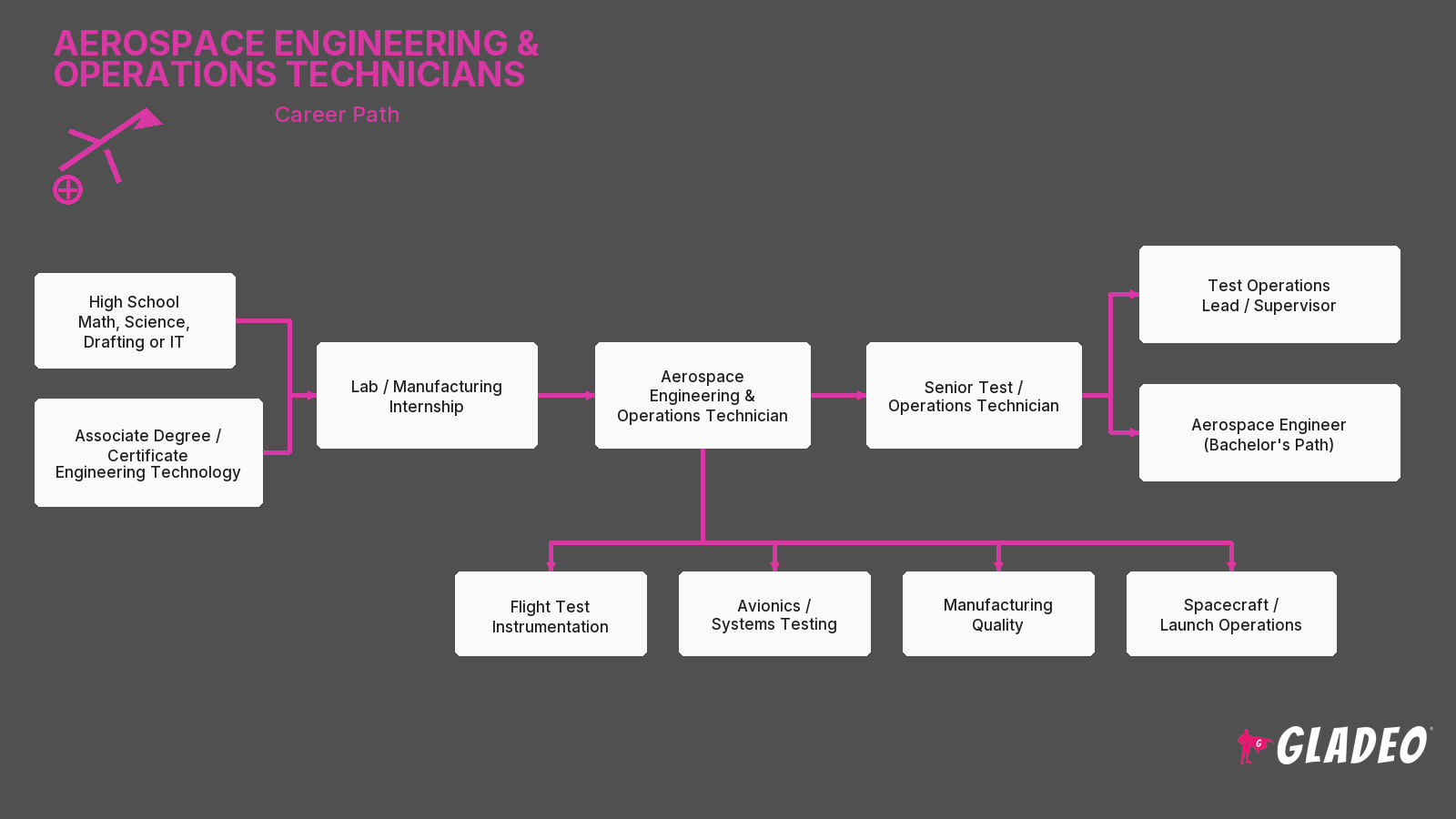
Most Aerospace Engineering & Operations Technicians earn an associate degree in aerospace, aviation maintenance, or engineering technology from a community college or technical school. Some pursue a bachelor's degree in aerospace engineering technology for broader responsibilities and faster advancement. Programs accredited by ABET are recognized by employers as meeting strong industry standards, and hands-on lab work is often just as important as classroom instruction.
Students can take courses in relevant subjects such as:
- Physics and Aerodynamics
- Calculus and Applied Mathematics
- Materials Science
- CAD and Engineering Drafting
- Electronics and Avionics Fundamentals
- Statistics and Data Analysis
- Manufacturing Processes
- Introduction to Systems Engineering
- Instrumentation and Data Acquisition
- Aircraft and Spacecraft Structures
Hands-on experience through internships, co-op programs, or part-time work in machine shops, maintenance hangars, or research labs gives students a real head start. Some technicians enter the field after military aviation maintenance training, which transfers well into civilian aerospace roles. Continuing education and industry certifications help technicians keep pace with new materials, testing methods, and evolving safety standards throughout their careers.
- Take physics, algebra, trigonometry, and calculus courses
- Enroll in drafting, CAD, shop, or engineering technology classes
- Join a robotics team, rocketry club, or aviation program like Civil Air Patrol
- Learn a free CAD program such as Fusion 360 or Onshape on your own
- Build and fly model rockets, RC aircraft, or drones
- Enter science fairs or engineering competitions involving building and testing
- Visit a local aerospace manufacturer, airport, or air show
- Look for summer STEM programs focused on aviation or aerospace
- Practice documenting projects with photos, sketches, and notes
- Get comfortable with spreadsheets and basic data analysis
- Apply for internships at machine shops, maintenance facilities, or makerspaces
- Talk to aerospace technicians and engineers about their day-to-day work
- ABET accreditation for engineering technology programs
- Modern labs with wind tunnels, CAD workstations, and test equipment
- Required internship or co-op placements with aerospace employers
- Instructors with real industry or military aviation experience
- Coursework in current CAD software and GD&T
- A capstone project where you design, build, and test something real
- Transfer agreements from associate to bachelor's programs
- Strong relationships with regional aerospace or defense companies
- Preparation for industry certifications
- Small lab sections that guarantee real time on equipment
- Career services that track job placement rates for graduates
- Access to internships with NASA, the military, or major manufacturers
- Complete at least one internship or co-op before graduation
- Build a portfolio of test reports, CAD models, and projects from school
- Apply for entry-level titles like Aerospace Technician, Test Technician, or Quality Inspector
- Search job boards, company career pages, and aerospace-focused hiring events
- Attend career fairs hosted by your school and by groups like AIAA and SME
- Earn a relevant certification, such as an NDT or quality inspection credential
- Highlight hands-on skills on your resume, including specific tools and tests you have run
- Practice explaining a project clearly in interviews, including what went wrong and how you fixed it
- Consider starting as a machinist, quality inspector, or maintenance technician to gain experience
- Network with instructors, alumni, and guest speakers from the aerospace industry
- Be open to relocating to regions with strong aerospace or defense manufacturing
- Show up with strong safety awareness; employers value attitude as much as raw skill
- Master advanced testing, data analysis, and CAD tools beyond your job requirements
- Volunteer for challenging test campaigns and cross-functional projects
- Complete a bachelor's degree if you started with an associate degree
- Pursue certifications in non-destructive testing, quality, or specialized systems
- Build a reputation for accurate data and dependable documentation
- Move into senior technician, lab supervisor, or engineering support roles
- Develop mentoring skills by training new technicians
- Stay active in professional organizations to learn about new methods and openings
Websites:
- American Institute of Aeronautics and Astronautics (AIAA) - aiaa.org
- Aerospace Industries Association - aia-aerospace.org
- SAE International - sae.org
- Society of Manufacturing Engineers (SME) - sme.org
- American Society for Nondestructive Testing - asnt.org
- Space Foundation - spacefoundation.org
- National Space Society - nss.org
- Association for Uncrewed Vehicle Systems International (AUVSI) - auvsi.org
- NASA STEM Engagement - nasa.gov/stem
- Aviation Week Network - aviationweek.com
- Aerospace America - aerospaceamerica.aiaa.org
- National Air and Space Museum - airandspace.si.edu
- SkillsUSA - skillsusa.org
- FIRST Robotics - firstinspires.org
Books:
- Skunk Works by Ben Rich and Leo Janos
- Rocket Boys by Homer Hickam
- Ignition! by John D. Clark
- Aerodynamics for Engineers by John J. Bertin and Russell M. Cummings
- The Right Stuff by Tom Wolfe
If you find that being an Aerospace Engineering & Operations Technician isn't the right fit, your hands-on testing, fabrication, and problem-solving skills transfer well to many related careers.
- Mechanical Engineering Technologist
- Avionics Technician
- Aircraft Mechanic
- Quality Control Inspector
- CNC Machinist
- Manufacturing Engineer
- Mechanical Drafter
- Electronics Technician
- Robotics Technician
- Industrial Engineering Technologist
Click here to download the infographic
Newsfeed

Featured Jobs
Online Courses and Tools