






Spotlights
Environmental Specialist, Environmental Technician, Environmental Field Technician, Environmental Engineering Technologist, Environmental Engineering Assistant, Engineering Technologist
Imagine walking through a forest, swimming in a clean lake, or breathing fresh air in a city—these experiences are safer and healthier thanks to Environmental Engineering Technicians. By testing water, soil, and air samples and helping design solutions, they ensure communities and ecosystems stay protected from pollution and environmental hazards.
Environmental Engineering Technicians collect samples from the environment, run tests in labs or onsite, and analyze data to support engineers and scientists who design systems to reduce pollution and manage waste. They collaborate with environmental engineers, scientists, government agencies, and contractors to monitor project progress and compliance with environmental regulations, ensuring that projects protect natural resources and public health.
Using specialized tools like sampling equipment, GPS devices, and laboratory instruments, Environmental Engineering Technicians apply scientific methods and technical skills to gather and interpret data. Their work is crucial for designing effective environmental solutions and maintaining safety standards, making a tangible difference in preserving the planet for future generations.
- Playing a role in the protection and preservation of our natural world
- Having the opportunity to be outside
- Being able to work in many types of capacities for different organizations
- Working with a team of like-minded professionals interested in making the world a safer place
- Educating others about the importance of caring for our environment
Working Schedule
Environmental Engineering Technicians often work full-time, with schedules that may vary based on projects. They split time between offices, laboratories, and outdoor field sites, sometimes working irregular hours to collect samples or monitor environmental conditions. While many are employed full-time by government agencies, engineering firms, or environmental consultancies, some work as contractors or freelancers, adjusting their schedules to meet project deadlines and seasonal demands.
Typical Duties
- Collecting soil, water, air, and biological samples from various environments for testing.
- Setting up and maintaining environmental monitoring equipment in the field.
- Performing laboratory tests to identify contaminants and measure pollution levels.
- Recording and analyzing data to support environmental assessments and reports.
- Assisting engineers in designing pollution control and waste treatment systems.
- Inspecting construction sites or industrial facilities to ensure environmental compliance.
- Operating GPS and mapping equipment to document sample locations.
- Preparing detailed technical reports and documentation for regulatory agencies.
- Calibrating and repairing sampling instruments and lab equipment.
- Following safety protocols to handle hazardous materials and protect the environment.
- Communicating findings to engineers, scientists, and regulatory personnel.
- Supporting environmental impact studies and remediation projects.
Additional Responsibilities
- Maintaining accurate records of field and lab activities.
- Training junior technicians or interns on procedures and safety.
- Coordinating with government officials during environmental inspections.
- Updating knowledge of environmental laws and technological advances.
- Participating in community outreach or education programs about environmental protection.
- Assisting with emergency response to environmental incidents or spills.
- Ordering and managing lab supplies and equipment inventory.
- Contributing to research projects by collecting and analyzing environmental data.
General skills
- Communication skills
- Critical thinking skills
- Observational skills
- Problem-solving skills
- Reading and written comprehension skills
- Active listening and learning
- Monitoring skills
- Judgement and decision making
- Deductive and inductive reasoning
- Quality control analysis
Technical skills
- Analytical or scientific software
- Compliance software
- Computer aided design (CAD) software
- Data base user interface and query software
- Development environment software
- Graphics or photo imaging software
- Map creation software
- Object or component oriented development software
- Spreadsheet software
- Word processing software
In the morning, an Environmental Engineering Technician reviews the day’s project plans and checks equipment to ensure it’s calibrated and ready for use. They might attend a briefing with engineers to discuss sample sites and safety procedures before heading out to the field.
Midday involves traveling to designated locations such as rivers, industrial sites, or wetlands to collect samples using specialized tools. This part of the day requires careful attention to detail to avoid contamination and accurate documentation of conditions and sample points.
In the afternoon and evening, they return to the lab to conduct tests on collected samples, input data into databases, and prepare reports. They collaborate with engineers and project managers to interpret results and plan next steps, sometimes working late to meet project deadlines or regulatory reporting requirements.
- Agri-food producers and distributors
- Engineering consulting firms
- Federal government departments
- Provincial/state government departments
- Municipal government departments
- Utility companies
- Energy companies
- Mining and lumber companies
- Colleges and universities
- Public and private research firms
- Special interest groups
- Non-profit organizations
- Conservation and environmental groups
- Chemical development and processing companies
- Field Technician: Focuses primarily on collecting environmental samples and monitoring conditions onsite.
- Laboratory Technician: Specializes in analyzing samples and conducting chemical and biological tests in a lab setting.
- Compliance Technician: Ensures that industrial and construction projects meet environmental regulations and standards.
- Remediation Technician: Assists with cleanup efforts and restoration of contaminated sites.
- Monitoring Technician: Operates and maintains equipment that tracks environmental parameters over time.
- Research Technician: Supports environmental research projects by gathering and analyzing data.
- Waste Management Technician: Works on projects related to proper disposal and treatment of hazardous and non-hazardous waste.
- Water Quality Technician: Concentrates on testing and improving the quality of surface and groundwater.
A willingness to take on new challenges in both laboratory and outdoor settings will help environmental engineering technicians move ahead. Sometimes longer hours are required if a major environmental issue or project is underway. Being flexible with your schedule will be an asset to your employer. As a side note, working with hazardous chemicals or in hazardous conditions can be stressful, so those in this profession will want to make sure that they are receiving proper training and equipment for the jobs they are assigned to.
In terms of skill building, because environmental issues can be controversial, learning how to talk about them diplomatically with the various people involved (community leaders, clients, residents) can be advantageous in this profession.
- Growing use of drones and remote sensing for environmental monitoring.
- Increased reliance on real-time data and automated sensors.
- Advancements in laboratory technologies for faster, more accurate testing.
- Expansion of environmental regulations driving demand for monitoring and compliance.
- Integration of Geographic Information Systems (GIS) in data analysis and mapping.
- Focus on sustainability and green infrastructure projects.
- Growing collaboration between engineers, scientists, and community stakeholders.
- Use of artificial intelligence and machine learning to predict environmental impacts.
- Emphasis on climate change adaptation and resilience planning.
- Development of new methods for detecting emerging contaminants.
As children, people in this profession were probably described as investigative and inquisitive. They would have had a methodical approach to solving problems. “Logical” and “analytical” are two words that would have been used to describe them.
In school, they had a natural inclination toward science or math classes and enjoyed the process of collecting data or information and being able to solve problems.
People who choose this field also enjoyed being outside as children and may have gotten absorbed in discovering the plants and animals that lived around them. These are the kids who liked to “get their hands dirty.” Many may have felt the importance of protecting the environment that these living things need to survive.
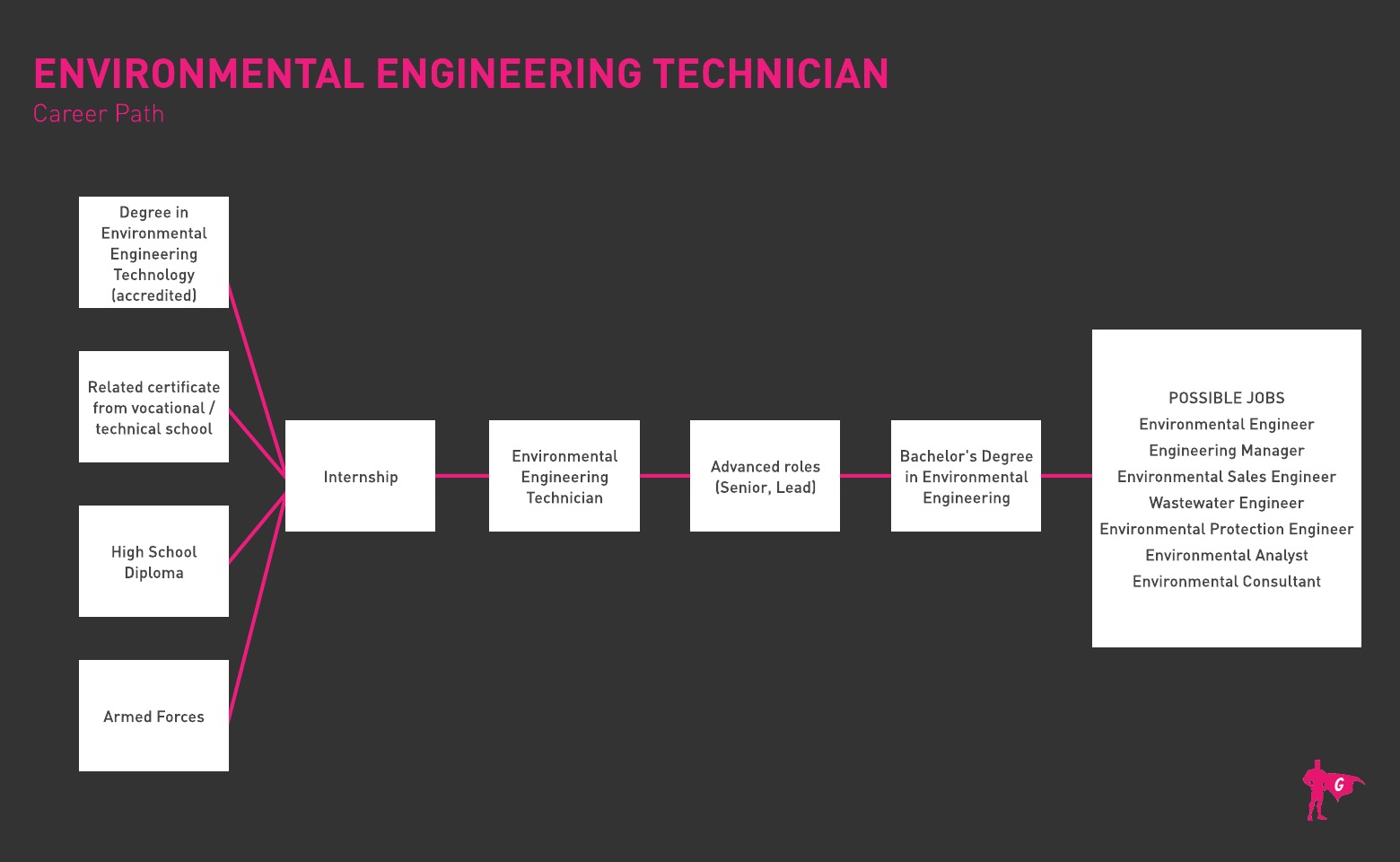
Becoming an Environmental Engineering Technician typically involves completing an associate degree or technical diploma in environmental science, environmental technology, or engineering technology. These programs provide hands-on training in sampling methods, laboratory techniques, and environmental regulations, preparing students for the technical demands of the role.
Students can take courses in relevant subjects such as:
- Environmental science
- Chemistry
- Biology and ecology
- Mathematics
- Geographic Information Systems (GIS)
- Technical writing and communication
- Health and safety practices
- Laboratory techniques
- Environmental regulations and compliance
- Computer applications and data analysis
Beyond formal education, gaining practical experience through internships or cooperative education programs is essential. Building a portfolio of hands-on projects, fieldwork, and lab skills helps candidates stand out. On-the-job training is common, where new technicians learn specific procedures and equipment use under supervision.
Classes to take:
- Biology
- Chemistry
- Engineering
- Technology/Computers
- Math
- English
- Environmental Science (if offered)
Activities to look into:
- Join science or math clubs that encourage you to work through problems.
- Enroll in engineering summer camps to help you explore your interests.
- Participate in activities that help you learn to work with others effectively in a group and share ideas and solutions.
- Become involved in environmental causes or local initiatives in your community to understand the kinds of issues you may encounter as an environmental engineering technician.
- Keep up to date on the latest issues affecting the environment and how different organizations are addressing these problems.
- Start or join an environmental awareness club at your high school or college to connect with others interested in the environmental field.
- Read articles and watch tutorials about Environmental Engineering Technicians work
- Interview a working Environmental Engineering
- Technician or see if you can shadow one for a day
- Get specialized with an in-demand certification
Technology and software to become familiar with include:
- Adobe PageMaker
- C++, Python
- Compliance software
- Computer-aided design
- Database user interface
- Development environment software
- Document management software
- GAEA Technologies WinSieve
- Geographic information system
- Industrial control software
- Map creation software
- Office suite software
- Photogrammetric software
- Choose programs with hands-on field and laboratory training.
- Look for accredited technical colleges or community colleges with environmental technology programs.
- Check if the program offers internship or cooperative education opportunities.
- Ensure courses cover environmental regulations and safety standards.
- Select programs teaching GIS and computer data analysis.
- Consider programs with modern lab facilities and equipment.
- Verify instructors have industry experience.
- Look for support services like career counseling and job placement.
- Choose programs that collaborate with local environmental agencies for real-world experience.
- Seek smaller class sizes for personalized instruction.
- Search online for volunteer opportunities with environmental causes and organizations. These types of activities demonstrate your passion for environmental issues to potential employers and may lead you to connections in the field.
- Join a professional organization to keep abreast of current issues and understand who the “movers and shakers” are.
- Include these volunteer activities and professional organizations on your resume. Take advantage of the career development office at your school to get help writing a professional, polished resume. Have several people look at it for their impression and suggestions.
- Have a general resume written, but tailor it for each job that you apply to. Read the job description carefully looking for the key words and phrases that are included. Tweak your resume to include these same key words and phrases so that your resume is selected.
- Research job opportunities using a variety of keywords that can describe the type of job you’re looking for. For example, use the terms environmental specialist, environmental technician, environmental engineering assistant, etc. Using different searches will yield more results.
- Set up search agents on job boards that look for new jobs that match your criteria so you can get notified of the latest positions as they become available.
- Contact organizations you would like to work for to see if scheduling an informational interview with someone there is possible. Even if no job is currently available, you have made a professional connection for the future.
- There are also several engineering-specific job boards, such as National Society of Professional Engineers, EngineeringJobs.net, IEEE Job Site, Society of Women Engineers, ASCE Career Connections, Society of Hispanic Professional Engineers, American Council of Engineering Companies, C&ENjobs, ASHRAE Jobs, and Tau Beta Pi The Engineering Honor Society
- Decide what type of organization you’d like to work for. 25% of workers in this field are employed by engineering services. 16% work for “management, scientific, and technical consulting services,” 16% work for government agencies, 12% work in waste management, and 9% are in manufacturing
- Per BLS, the states with the highest employment of Environmental Engineering Technicians are Texas, California, South Carolina, Florida, and Ohio
- Ask former professors, supervisors, and co-workers in advance if they’ll act as personal references
- Spend some time thinking about what areas of environmental engineering technology interest you most and pursue opportunities and certifications in those areas.
- Ask your supervisor if you can be trained in any additional areas that may be helpful to him or her; thereby alleviating some of their workload.
- Develop good relationships with the environmental engineers and other technicians you work with. Be a good listener and be open to their feedback.
- Your reputation speaks volumes about you. Always make sure you are putting forth your best effort. Make it easy for anyone who works with you to have a positive remark about you.
- Always have an up-to-date resume on hand. As you are learning new skills and increasing your knowledge in specific areas, add this information to your resume. It is much easier to do in the moment, rather than trying to remember things you want to include later.
- Talk with people in similar lines of work to see what their jobs entail and what kinds of openings they know of that you would be qualified for.
- Consider continuing your education. With a bachelor’s degree, you could advance to the position of environmental engineer – increasing your salary and career opportunities.
Websites:
- Environmental Protection Agency (EPA) – epa.gov
- National Society of Environmental Engineers – nsee.org
- Association of Environmental Engineering and Science Professors – aeesp.org
- Environmental Career Center – environmentalcareer.com
- Society for Environmental Toxicology and Chemistry – setac.org
- American Society of Civil Engineers – asce.org
- National Environmental Monitoring Conference – nemc.us
- Environmental Science Association – environmentalscience.org
- Green Jobs Network – greenjobs.com
- Environmental Defense Fund – edf.org
- CareerOne Environmental Network – careerone.com/environment
- Environmental Consultants Association – ecanet.org
- International Environmental Technology Council – ietcc.org
- Environmental Data Standards Council – edscouncil.org
Books:
- Environmental Engineering: Fundamentals, Sustainability, Design by James R. Mihelcic
- Introduction to Environmental Engineering and Science by Gilbert M. Masters and Wendell P. Ela
- Environmental Science: A Global Concern by William Cunningham and Mary Cunningham
- Contaminant Hydrogeology by C.W. Fetter
- Water Quality Engineering: Physical / Chemical Treatment Processes by Mark M. Benjamin
If you enjoy environmental science and technical work but want to explore other career paths, there are many related fields where your skills can shine.
- Environmental science and protection technician
- Geological sample technician
- Precision agriculture technician
- Robotics technician
- Mechanical engineering technician
- Electronics engineering technologist
- Surveying technician
- Forest and conservation technician
- Occupational health and safety technician
- Construction building inspector
Newsfeed

Featured Jobs
Online Courses and Tools
Annual Salary Expectations
New workers start around $45K. Median pay is $53K per year. Highly experienced workers can earn around $68K.