






Spotlights
Personal Injury Attorney, Accident Attorney, Trial Lawyer, Plaintiff's Attorney, Injury Claims Lawyer, Auto Accident Attorney, Workers' Compensation Attorney, Product Liability Lawyer, Litigation Attorney, Negligence Attorney, Civil Litigation Lawyer, Injury Compensation Counsel
A car crash on the highway, a fall on a poorly maintained sidewalk, a defective product that hurts the person using it exactly as intended, these moments can upend a life in seconds. Personal Injury Lawyers step in afterward to make sure the people responsible are held accountable and the people harmed get the compensation they need to heal, rebuild, and move forward.
Personal Injury Lawyers represent people injured in car accidents, workplace incidents, slip-and-falls, and by defective products, going up against insurance companies and the attorneys who defend at-fault parties. They interview clients about what happened, gather evidence like police reports and medical records, negotiate aggressively with insurance adjusters who often try to minimize payouts, and take cases to trial when a fair settlement cannot be reached. Along the way they work with investigators, medical experts, and accident reconstruction specialists to prove exactly what happened and how much it cost their client, physically, financially, and emotionally.
Most Personal Injury Lawyers work on contingency, meaning they only get paid if their client wins, which means every case is a shared investment in a fair outcome. Using tools like case management software, medical record databases, and settlement negotiation strategy, they turn a client's worst day into a path toward real recovery. Their work matters because without a skilled advocate, injured people are often outmatched by insurance companies with teams of lawyers working to pay out as little as possible.
- Winning fair compensation for clients facing medical bills, lost wages, and long recoveries
- Standing up for everyday people against powerful insurance companies
- Building genuine relationships with clients during a difficult, vulnerable time
- Seeing a case through from a client's worst day to real financial and emotional relief
Working Schedule
Most Personal Injury Lawyers work full-time, and workload often intensifies as trial dates approach or when negotiating a major settlement. Since most cases are handled on contingency, attorneys manage multiple cases simultaneously to keep a steady income flow, which means juggling client calls, depositions, and negotiations throughout the week. The job is mostly office-based, with time in court for hearings and trials, and some travel to accident scenes, client homes, or medical facilities. Personal Injury Lawyers work at plaintiff-side firms of all sizes, from small boutique practices to large regional firms, and a smaller number work in-house for insurance companies on the defense side.
Typical Duties
- Meeting with injured clients to understand what happened and assess case strength
- Gathering evidence such as police reports, medical records, and witness statements
- Negotiating settlements directly with insurance adjusters and opposing counsel
- Filing lawsuits when fair settlements cannot be reached through negotiation
- Taking depositions of witnesses, defendants, and expert witnesses
- Working with accident reconstruction experts and medical professionals to build a case
- Calculating damages, including medical costs, lost wages, and pain and suffering
- Preparing and presenting evidence and arguments at trial
- Advising clients on medical treatment documentation that strengthens their claim
- Reviewing insurance policies to determine coverage and liability limits
- Drafting demand letters, complaints, and settlement agreements
- Managing client communication and expectations throughout a lengthy claims process
Additional Responsibilities
- Marketing legal services and building a network of referral sources
- Managing a contingency-based caseload and firm cash flow
- Staying current on tort law, insurance regulations, and case precedent
- Training or supervising paralegals and case managers
- Reviewing medical bills and negotiating liens with healthcare providers
- Participating in mediation and alternative dispute resolution
- Attending continuing legal education focused on personal injury litigation
- Advocating for injured clients' rights through professional associations
A Personal Injury Lawyer's morning often starts by reviewing new intake calls from potential clients, deciding which cases have strong merit and clear liability. They might spend time on the phone with an insurance adjuster, pushing back on a lowball settlement offer for a client still recovering from a car accident.
Midday often includes client meetings, checking in on a client's medical treatment progress or explaining a settlement offer and what it does and does not cover. They may also review medical records and bills to calculate the true cost of an injury, factoring in future treatment, lost income, and the toll the injury has taken on the client's daily life.
Afternoons can bring a deposition, questioning a witness or defendant about the events leading up to an accident, or preparing evidence for an upcoming trial. Personal Injury Lawyers often spend evenings drafting demand letters or reviewing case files, since the volume of active cases at any given time requires constant organization and follow-up.
Soft Skills
- Persuasive negotiation
- Empathy for clients recovering from injury and trauma
- Strong written and oral communication
- Persistence when facing resistant insurance companies
- Confidence in courtroom advocacy
- Active listening and client relationship management
- Organizational skills to manage many active cases
- Resilience through lengthy claims and litigation processes
- Sound judgment evaluating case value and strategy
- Comfort with public speaking and cross-examination
- Ethical rigor in representing client interests
- Adaptability when negotiations shift or fall apart
Technical Skills
- Deep knowledge of tort and personal injury law
- Legal research and case law analysis
- Deposition and courtroom litigation skills
- Insurance policy and coverage analysis
- Damages calculation, including future medical costs and lost earning capacity
- Negotiation and settlement strategy
- Understanding of medical terminology related to common injuries
- Familiarity with accident reconstruction and expert witness coordination
- Legal case management and client intake software
- Knowledge of workers' compensation and product liability law
- Auto Accident Attorney: Focuses on car, motorcycle, and truck accident claims
- Workers' Compensation Attorney: Represents employees injured on the job
- Product Liability Attorney: Handles cases involving defective or dangerous products
- Premises Liability Attorney: Focuses on slip-and-fall and unsafe property cases
- Wrongful Death Attorney: Represents families after a death caused by negligence
- Catastrophic Injury Attorney: Handles severe, life-altering injury cases
- Insurance Defense Attorney: Represents insurance companies and at-fault parties
- Mass Tort Attorney: Handles large-scale cases involving many injured plaintiffs
- Plaintiff-side personal injury law firms
- Insurance defense law firms
- Insurance companies and their in-house legal departments
- Workers' compensation boards and agencies
- Legal aid organizations serving injured low-income clients
- Solo private practice
- Large national personal injury firms
- Product manufacturers' legal departments
- Trial lawyer associations and advocacy organizations
- Government agencies handling public liability claims
- Mediation and arbitration service providers
- Corporate risk management and liability departments
Because most Personal Injury Lawyers work on contingency, they take on real financial risk with every case, investing time, resources, and often money for expert witnesses and court costs without any guarantee of payment. This makes case selection and negotiation skill critical to keeping a practice financially healthy.
Negotiating with insurance companies can be an exhausting, adversarial process. Adjusters are trained to minimize payouts, and Personal Injury Lawyers must be prepared to push back firmly, sometimes for months, before reaching a fair settlement or deciding to take a case to trial. This requires patience and a thick skin.
The work also involves supporting clients through pain, financial stress, and uncertainty, which can be emotionally demanding over time. Trial preparation can mean long hours in the weeks before a court date, and building and maintaining a busy caseload requires strong organizational discipline to make sure no client's case loses momentum.
- Growing use of telemedicine records as evidence in injury claims
- Increased use of litigation funding to support long or expensive cases
- Rising attention to distracted driving and rideshare accident litigation
- Greater use of social media evidence in both building and defending against claims
- Expansion of legal tech tools for case management and settlement calculation
- Growing focus on traumatic brain injury and long-term disability claims
- Increased scrutiny of nursing home and long-term care negligence cases
- Rising use of mediation and arbitration to resolve cases faster
- More attention to mass tort and class action litigation for defective products
- Growing use of data analytics to predict case value and settlement outcomes
Many Personal Injury Lawyers were natural advocates as kids, standing up for classmates who were treated unfairly and enjoying debate, mock trial, or student government. They tended to be persuasive communicators who liked winning an argument with facts and logic rather than volume.
Others were drawn to helping people directly, whether through volunteering, tutoring, or working part-time jobs that involved customer service and conflict resolution. A combination of a strong sense of justice, comfort with confrontation when needed, and genuine care for people in difficult situations often points toward this career.
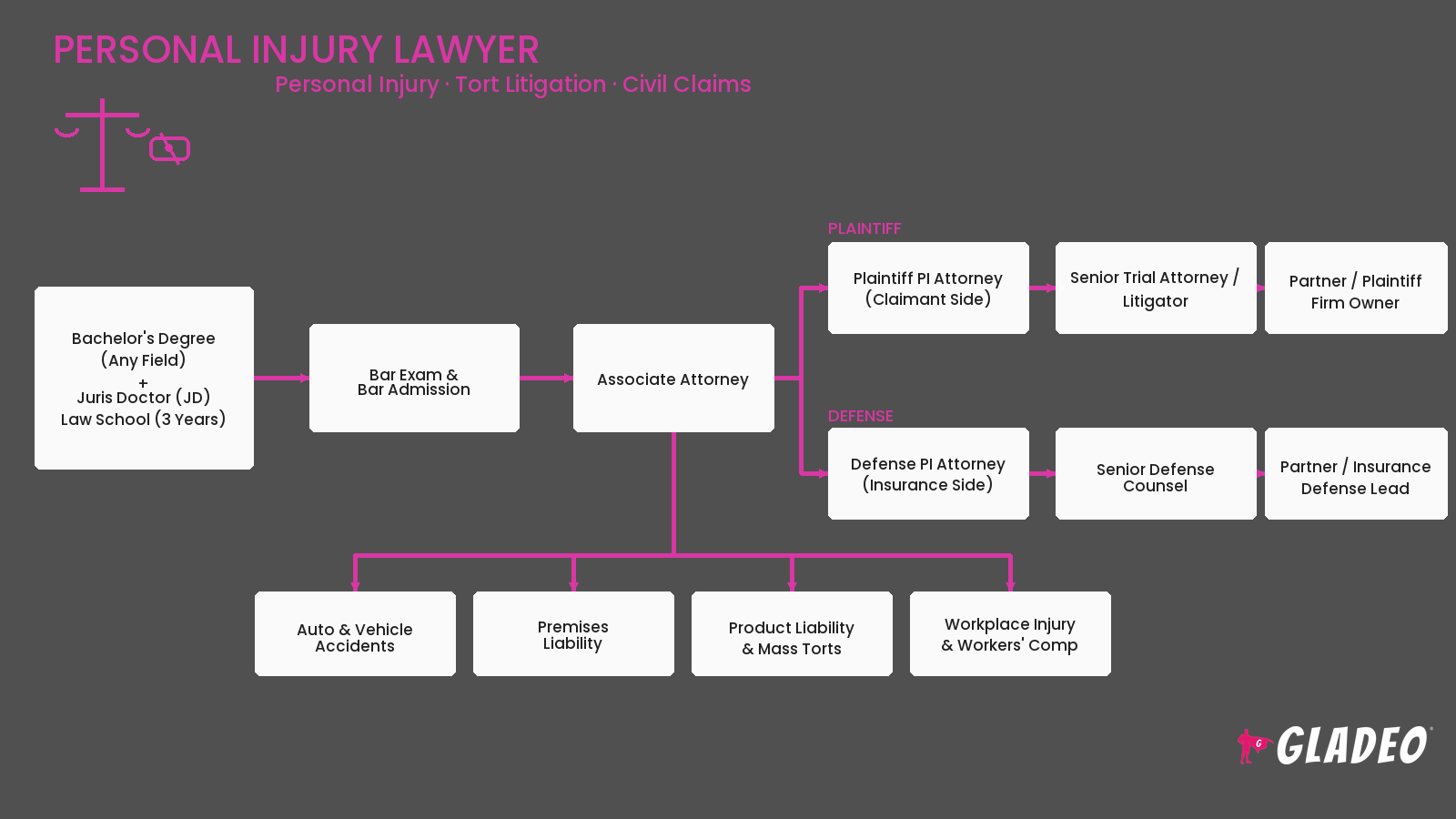
Becoming a Personal Injury Lawyer starts with a four-year bachelor's degree in any field, though political science, communications, and business are common choices. Law school follows, a three-year program leading to a Juris Doctor (JD) degree, with coursework in torts, evidence, and trial advocacy being especially relevant. After graduation, passing the state bar exam is required to practice, and many aspiring Personal Injury Lawyers gain early experience through law firm internships or clerkships in litigation.
Students can take courses in relevant subjects such as:
- Torts and Personal Injury Law
- Civil Procedure
- Evidence and Trial Advocacy
- Insurance Law
- Negotiation and Alternative Dispute Resolution
- Contracts
- Legal Writing and Research
- Damages and Remedies
- Workers' Compensation Law
- Product Liability Law
Hands-on experience matters a great deal in this field. Internships or clerkships at plaintiff-side or insurance defense firms give students real exposure to client intake, negotiation, and courtroom procedure. Many Personal Injury Lawyers start their careers doing intake and case investigation work before taking on full case management, building practical skills that classroom learning cannot fully teach. Continuing legal education keeps practicing attorneys sharp on evolving tort law and negotiation tactics.
- Join debate team or mock trial to build persuasive speaking and argument skills
- Take psychology classes to understand how to connect with clients and juries
- Volunteer or work in a customer-facing role to build negotiation and communication skills
- Shadow a personal injury attorney or observe a civil trial, many of which are open to the public
- Research pre-law tracks and law schools with strong trial advocacy programs
- Practice writing persuasively through school newspapers or debate competitions
- Talk to personal injury attorneys or paralegals about their day-to-day work
- Take business and math classes to build comfort with damages and settlement calculations
- Explore internships or part-time work at law firms during summers
- Study government and civics to understand how the civil court system works
- Build resilience through competitive activities like sports or debate that involve setbacks and comebacks
- Practice explaining complicated situations clearly and persuasively to others
- Law schools with strong trial advocacy or litigation clinics
- Faculty with real personal injury litigation experience
- Strong bar passage rates in the state where you plan to practice
- Opportunities for externships with personal injury firms or insurance companies
- Coursework in torts, evidence, negotiation, and damages
- Access to mock trial and moot court competitions
- Career services with connections to plaintiff-side and defense-side litigation firms
- Programs offering practical skills training in client intake and case management
- Strong alumni network in personal injury and civil litigation
- Opportunities to participate in real negotiation or mediation exercises
- Support for entrepreneurial paths, since many Personal Injury Lawyers eventually open their own firms
- Flexible scheduling if you plan to work while attending law school
- Complete an internship or clerkship at a personal injury or insurance defense law firm
- Seek entry-level roles such as Associate Attorney or Case Manager at a personal injury firm
- Build negotiation experience through school competitions or part-time customer service roles
- Volunteer for legal aid clinics that handle injury or workers' compensation cases
- Network through your state bar's trial lawyers or litigation section
- Highlight any client intake, negotiation, or case management experience on your resume
- Pass the bar exam and consider joining the American Association for Justice
- Practice explaining a mock case's value and strategy clearly in interviews
- Consider starting as a case manager or paralegal to learn the intake process from the ground up
- Attend personal injury law conferences and CLE seminars to meet practicing attorneys
- Offer to help senior attorneys with case investigation to prove your work ethic and attention to detail
- Show genuine empathy and confidence in interviews, since clients need to trust you immediately
- Take on increasingly complex or high-value injury cases
- Build a reputation for strong settlement results and trial readiness
- Develop a steady referral network among doctors, chiropractors, and other attorneys
- Pursue trial advocacy certifications to sharpen courtroom skills
- Publish articles or speak at CLE events to establish expertise in a subspecialty
- Move from associate to partner, or open your own personal injury practice
- Mentor junior attorneys and case managers on negotiation strategy
- Get involved in trial lawyer associations for leadership and networking opportunities
Websites:
- American Association for Justice - justice.org
- American Bar Association Tort Trial and Insurance Practice Section - americanbar.org
- National Trial Lawyers Association - thenationaltriallawyers.org
- Insurance Information Institute - iii.org
- Defense Research Institute - dri.org
- Justia Personal Injury Law Center - justia.com/injury
- FindLaw Personal Injury Center - findlaw.com/injury
- American Board of Trial Advocates - abota.org
- National Highway Traffic Safety Administration - nhtsa.gov
- Consumer Product Safety Commission - cpsc.gov
- Law School Admission Council (LSAC) - lsac.org
- American Association of Justice Trial Lawyers Section - justice.org
- National Association of Insurance Commissioners - naic.org
- AVVO Personal Injury Legal Resources - avvo.com
Books:
- The Trial Lawyer's Art by Sam Schrager
- Rules of the Road by Rick Friedman and Patrick Malone
- A Civil Action by Jonathan Harr
- The Empty Chair by David Ball
- How to Win Your Personal Injury Claim by Joseph L. Matthews
If you find that being a Personal Injury Lawyer isn't the right path for you, your skills in negotiation, advocacy, and case analysis transfer well to related careers.
- Insurance Claims Adjuster
- Workers' Compensation Case Manager
- Paralegal in Litigation
- Mediator or Arbitrator
- Risk Management Specialist
- Insurance Defense Attorney
- Legal Case Manager
- Victim Advocate
- Court Reporter or Legal Transcriptionist
- Contract Negotiator
Click here to download the infographic
Newsfeed

Featured Jobs
Online Courses and Tools