





Spotlights
Foot Doctor, Podiatric Physician, Chiropodist, Podiatric Surgeon, Orthopedic Podiatrist, Pediatric Podiatrist, Sports Podiatrist, Diabetic Foot Specialist, Geriatric Podiatrist, Podiatric Clinician, Foot and Ankle Specialist, Podiatric Consultant
Every step you take depends on the health of your feet and ankles, and podiatrists are the unsung heroes ensuring that people can move comfortably and confidently every day. From athletes recovering from injuries to seniors managing chronic conditions, podiatrists make a vital impact on quality of life.
Podiatrists diagnose, treat, and prevent problems related to the foot, ankle, and lower leg. Their daily work involves examining patients, ordering x-rays or lab tests, creating treatment plans, performing surgeries, and providing rehabilitation advice. They often collaborate with primary care doctors, physical therapists, orthopedic surgeons, and diabetic specialists to deliver comprehensive care that keeps patients mobile and pain-free.
Using specialized diagnostic tools like imaging technology and custom orthotic devices, podiatrists apply medical knowledge and surgical skills to treat ailments such as fractures, infections, deformities, and circulation issues. Their role is crucial in preventing minor foot problems from turning into serious disabilities, especially for patients with diabetes or arthritis.
- Helping bring fresh, healthy fruit to the community and improving food quality worldwide.
- Solving complex biological and environmental challenges through research and innovation.
- Working outdoors in orchards and labs while connecting science with nature.
- Seeing the direct impact of your work on farmers’ success and consumers’ enjoyment.
Pomologists typically have a mix of outdoor and indoor work environments, shifting between orchards, labs, and offices. Their schedules can vary seasonally—longer hours during planting and harvest seasons, and more regular hours during research periods. Many work full-time, sometimes managing deadlines related to crop cycles, and may travel to farms or research sites. Some pomologists work as consultants or in academic roles with more flexible hours.
Typical Duties
- Conduct field experiments to test fruit varieties and cultivation methods.
- Monitor fruit tree health and growth cycles.
- Analyze soil and plant samples to optimize growing conditions.
- Identify and manage pests and diseases affecting fruit crops.
- Collaborate with farmers and agricultural technicians to implement best practices.
- Develop new fruit cultivars through breeding and genetic research.
- Record and interpret data on fruit yield, quality, and environmental factors.
- Present research findings to growers, scientists, and industry groups.
- Write reports and scientific papers on pomology studies.
- Advise on orchard design and fruit harvesting techniques.
- Stay updated on agricultural regulations and safety standards.
- Assist in teaching or extension programs for farmers and students.
Additional Responsibilities
- Maintain detailed records of experiments and orchard conditions.
- Manage budgets and resources for research projects.
- Train junior scientists or agricultural workers.
- Participate in conferences and industry workshops.
- Secure funding through grant writing for research initiatives.
- Ensure compliance with environmental and safety regulations.
- Promote sustainable agriculture and conservation practices.
- Consult with policymakers on agricultural and food production issues.
Mornings often start with reviewing weather and orchard reports, planning daily tasks like sample collection and field inspections.
Midday involves hands-on work in the orchard or lab: collecting fruit samples, examining tree health, or running soil tests. They analyze data and troubleshoot any crop issues discovered during fieldwork.
Afternoons are spent meeting with farmers to discuss findings, collaborating with research teams, and preparing reports or presentations for upcoming conferences or stakeholders.
Soft Skills
- Empathy to understand patient pain and concerns.
- Strong communication to explain treatments and build trust.
- Attention to detail in diagnosis and treatment.
- Problem-solving to create effective care plans.
- Patience when working with chronic conditions.
- Manual dexterity for surgical and physical tasks.
- Critical thinking to analyze test results and symptoms.
- Teamwork with other healthcare providers.
- Adaptability to handle emergencies and new cases.
- Time management to balance appointments and procedures.
- Ethical judgment in patient care decisions.
- Emotional resilience for dealing with patient suffering.
Technical Skills
- Knowledge of human anatomy, especially lower limb structure.
- Proficiency in diagnostic imaging interpretation.
- Surgical skills for foot and ankle procedures.
- Skill in fitting and prescribing orthotic devices.
- Understanding of pharmacology for pain and infection control.
- Competence with electronic health records software.
- Ability to perform wound care and infection management.
- Knowledge of rehabilitation and physical therapy techniques.
- Familiarity with sterile techniques and safety protocols.
- Use of patient education tools and materials.
- Research Pomologist: Focuses on experimental studies to develop new fruit varieties and growing methods.
- Extension Pomologist: Works directly with farmers and communities to share knowledge and improve practices.
- Commercial Pomologist: Manages fruit production for large-scale orchards or farms.
- Breeding Pomologist: Specializes in genetic improvement and cross-breeding of fruit crops.
- Postharvest Pomologist: Studies storage, transportation, and shelf-life of harvested fruit.
- Environmental Pomologist: Concentrates on ecological impacts and sustainable fruit production.
- Consultant Pomologist: Advises growers and companies on best practices and problem-solving.
- Academic Pomologist: Teaches and conducts research at universities or colleges.
- Agricultural research institutes
- Universities and colleges with agricultural programs
- Fruit growing cooperatives and associations
- Government agricultural departments and extension services
- Private agricultural companies and nurseries
- Food and beverage companies focusing on fruit products
- Environmental and sustainability organizations
- Orchard management companies
- Biotechnology firms specializing in plant genetics
- Nonprofit organizations promoting sustainable agriculture
- Agricultural equipment and technology firms
- Agricultural consulting firms
Pomologists often face pressure to produce results that can directly impact food supply and farmer livelihoods, requiring careful and accurate research under seasonal constraints.
Work hours can be demanding during planting and harvest seasons with early mornings or long days outdoors, while research phases may offer more regular schedules but still require intense data analysis and reporting.
This career requires balancing detailed, patient research with practical applications, which can involve setbacks like crop failures or unpredictable weather, demanding resilience and adaptability.
- Increasing use of drone and satellite technology to monitor orchards remotely.
- Advancements in genetic engineering for disease-resistant fruit varieties.
- Growing focus on sustainable and organic fruit production methods.
- Integration of data analytics and AI to optimize crop management.
- Climate change prompting research into more resilient fruit crops.
- Expansion of urban and vertical farming for fruit production.
- Greater collaboration between international agricultural researchers.
- Use of biodegradable materials for fruit packaging to reduce waste.
- Emphasis on reducing pesticide use through biological pest control.
- Development of precision agriculture tools tailored for fruit crops.
Many pomologists showed an early love for nature, gardening, and science experiments, often fascinated by how plants grow and produce fruit.
They enjoyed outdoor activities like visiting farms or orchards, collecting seeds, and observing plant life cycles, showing curiosity about the natural world and food origins.
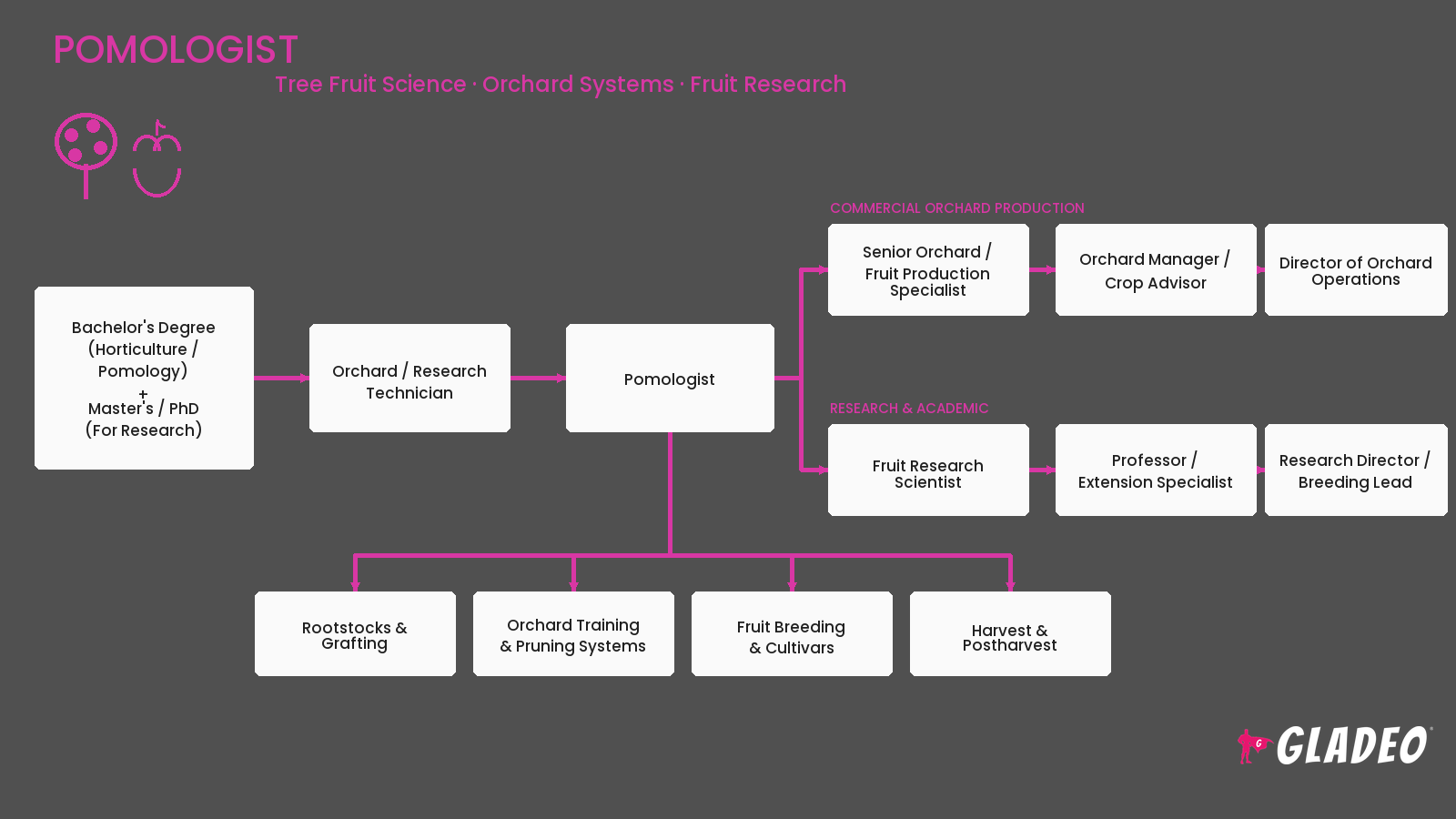
Becoming a pomologist typically involves studying agriculture, horticulture, plant science, or related fields. Many professionals earn a bachelor's degree in these areas, followed by specialized training or graduate studies focused on fruit crops and plant biology.
Students can take courses in relevant subjects such as:
- Botany and Plant Biology
- Horticulture and Fruit Crop Production
- Soil Science and Fertility
- Plant Genetics and Breeding
- Plant Pathology and Pest Management
- Agricultural Chemistry
- Environmental Science
- Agricultural Economics and Extension
- Data Analysis and Statistics
- Laboratory Techniques in Plant Science
Hands-on experience through internships, fieldwork, and research projects is essential for building practical skills. Developing a portfolio of research and field accomplishments can help with job opportunities. Some pomologists pursue advanced degrees for research and academic careers, while others gain expertise through on-the-job training and extension programs.
- Join agriculture or science clubs at school to explore plant biology and farming concepts.
- Volunteer or intern on local farms or in community gardens to gain practical experience.
- Take advanced science classes like biology, chemistry, and environmental science.
- Participate in science fairs or competitions focused on plant or environmental topics.
- Attend workshops or summer programs related to horticulture or agriculture.
- Connect with agricultural extension offices or university programs for mentorship opportunities.
- Develop computer skills, especially in data analysis and research tools.
- Explore local orchards or botanical gardens to learn about fruit crops firsthand.
- Consider dual enrollment courses in agriculture or biology during high school.
- Build strong communication skills through presentations and writing about science projects.
- Look for programs with hands-on lab and fieldwork opportunities in horticulture or plant sciences.
- Choose schools with faculty experienced in fruit crop research or extension services.
- Seek programs that offer internships or connections to local farms and orchards.
- Verify availability of courses in plant breeding, pest management, and soil science.
- Check for access to modern laboratory and agricultural technology.
- Consider programs with strong ties to agricultural industry organizations.
- Evaluate support for student research projects and conference participation.
- Look for curriculum including sustainable and organic farming methods.
- Investigate opportunities for study abroad or exchange programs focused on agriculture.
- Assess career services and networking opportunities in the agricultural sector.
- Prefer programs that teach data analysis and agricultural software skills.
- Ensure the program provides training in communication and extension education.
- Apply for internships or assistant roles at agricultural research centers or universities.
- Volunteer with local extension offices or community agriculture projects.
- Gain experience in orchard maintenance and fruit harvesting.
- Assist in laboratory work analyzing plant and soil samples.
- Help collect and record data for agricultural experiments.
- Work with agricultural consultants or crop advisors.
- Participate in pest scouting and disease monitoring programs.
- Support plant breeding or propagation activities.
- Attend and help organize agricultural workshops or field days.
- Build a network with farmers, scientists, and industry professionals.
- Create a portfolio documenting your research and fieldwork experiences.
- Practice presenting findings and writing reports to improve communication skills.
- Pursue advanced degrees (Master's or PhD) for research or teaching positions.
- Develop expertise in specialized areas like genetic breeding or pest management.
- Build strong relationships with growers and agricultural organizations.
- Publish research in scientific journals and present at conferences.
- Gain leadership experience by managing projects or teams.
- Stay current with technological advances and industry trends.
- Expand skills to include data science and precision agriculture tools.
- Seek mentorship and professional certifications in agriculture.
Websites:
- American Society for Horticultural Science (ashs.org)
- International Society for Horticultural Science (ishs.org)
- United States Department of Agriculture (usda.gov)
- National Agricultural Library (nal.usda.gov)
- Fruit Growers News (fruitgrowersnews.com)
- Horticulture Innovation Lab (horticulture.ucdavis.edu)
- The Orchard Magazine (orchardmagazine.com)
- Sustainable Agriculture Research and Education (sare.org)
- Plant Breeding and Genomics Community (plant-breeding.org)
- Extension Foundation (extension.org)
- AgriLife Extension Texas A&M (agrilifeextension.tamu.edu)
- Society for Horticultural Science (societyforhorticulturalscience.org)
- AgWeb (agweb.com)
- Agri-Pulse (agri-pulse.com)
Books:
- Pomology: Principles and Practice by J. R. Brown
- Fruit Breeding by Jules Janick and James N. Moore
- Plant Propagation: Principles and Practices by Hudson T. Hartmann and Dale E. Kester
- The Biology of Fruit Crops by R. J. Summerfield
- Tree Fruit Science and Practice by B. Schaffer and P. C. Andersen
If a career directly as a pomologist isn’t the perfect fit, there are many related paths where your skills in plant science, agriculture, and research can shine.
- Agricultural Technician
- Horticulturist
- Plant Geneticist
- Crop Consultant
- Soil Scientist
- Environmental Scientist
- Agricultural Extension Agent
- Food Scientist
- Landscape Architect
- Biotechnologist
Click here to download the infographic
Newsfeed

Featured Jobs
Online Courses and Tools