






Spotlights
Tax Attorney, Taxation Counsel, Tax Litigation Attorney, IRS Dispute Attorney, Tax Controversy Attorney, Corporate Tax Counsel, Estate and Tax Planning Attorney, International Tax Attorney, Tax Compliance Counsel, Tax Court Litigator, Transactional Tax Attorney, Trusts and Tax Attorney
Behind every major business deal, every family fortune passed to the next generation, and every dispute with the IRS is a set of tax rules so complex that even experts spend careers mastering them. Tax Lawyers are the ones who make sense of that complexity, saving clients money, keeping them out of legal trouble, and stepping in to fight for them when the government comes calling.
Tax Lawyers advise individuals and businesses on how to structure their finances, transactions, and estates in ways that are both smart and fully compliant with the law, while also representing clients in disputes with the Internal Revenue Service (IRS) and in United States Tax Court when disagreements cannot be resolved. Their days might involve structuring a merger to minimize tax exposure, advising a family on an estate plan that protects generational wealth, or building a case to defend a client during an IRS audit. They work closely with accountants, financial advisors, corporate executives, and sometimes forensic auditors to build airtight strategies and defenses.
Using tools like tax code research databases, financial statements, IRS correspondence, and case law from tax court rulings, Tax Lawyers turn dense regulation into clear, actionable strategy. Their work matters because tax law touches nearly every major financial decision a person or company makes, and a single misstep can mean steep penalties, audits, or years of legal battles. For students who enjoy precise, analytical thinking and want to work at the intersection of law, business, and numbers, this is one of the most intellectually demanding and well-respected paths in the legal field.
- Solving complex financial puzzles that save clients significant money legally
- Successfully defending clients in high-stakes disputes with the IRS
- Helping families protect and pass on wealth through smart estate planning
- Combining rigorous analytical thinking with real strategic and financial impact
Working Schedule
Most Tax Lawyers work full-time, and hours can intensify sharply around major deadlines like tax filing season, fiscal year-end for corporate clients, or the closing of a large transaction. Much of the work happens in an office reviewing financial documents and researching tax code, though litigation-focused Tax Lawyers spend time in Tax Court or in meetings with IRS agents. Tax Lawyers work at large law firms with dedicated tax departments, accounting firms with legal divisions, corporate legal departments, boutique tax law firms, or as solo practitioners handling individual tax disputes and estate planning.
Typical Duties
- Advising individuals and businesses on tax-efficient ways to structure transactions
- Researching and interpreting federal, state, and international tax law
- Representing clients during IRS audits and examinations
- Preparing and arguing cases before the United States Tax Court
- Drafting estate plans, trusts, and wills with tax-minimization strategies
- Structuring mergers, acquisitions, and business formations to reduce tax liability
- Responding to IRS notices, penalty assessments, and collection actions
- Advising on international tax compliance for businesses operating across borders
- Negotiating settlements and payment plans with the IRS on behalf of clients
- Reviewing corporate tax filings for compliance and risk exposure
- Advising nonprofit organizations on maintaining tax-exempt status
- Drafting legal opinions on the tax consequences of complex transactions
Additional Responsibilities
- Staying current on constantly changing federal and state tax legislation
- Coordinating with accountants and financial advisors on client strategy
- Training or supervising junior associates and tax paralegals
- Reviewing and advising on payroll and employment tax compliance
- Managing detailed, deadline-driven caseloads during tax season
- Participating in continuing legal education focused on tax law updates
- Advising clients on the tax implications of major life events like divorce or inheritance
- Representing clients in state and local tax disputes in addition to federal matters
A Tax Lawyer's morning often starts with reviewing a stack of IRS correspondence for a client under audit, cross-referencing every claim against financial records and the relevant tax code sections. They might spend an hour researching a recent Tax Court ruling that could affect a case they are currently building.
Midday often includes client meetings, walking a small business owner through the tax implications of restructuring their company, or advising a family on how to set up a trust that minimizes estate tax for the next generation. They may also join a call with a company's accounting team to review a proposed merger and flag any tax risks before the deal moves forward.
Afternoons can bring a meeting with an IRS agent to negotiate a settlement on behalf of a client facing significant penalties, or focused, heads-down time drafting a legal memo analyzing a complicated international tax question. Tax season brings a noticeably faster pace, with Tax Lawyers fielding urgent questions from clients and coordinating closely with accountants to meet filing deadlines.
Soft Skills
- Strong analytical and logical thinking
- Attention to detail with numbers and complex regulations
- Clear written and verbal communication for translating technical concepts
- Patience and persistence researching dense legal material
- Negotiation skills for IRS disputes and settlements
- Discretion and confidentiality with sensitive financial information
- Composure under audit or litigation pressure
- Organizational skills to manage detailed, deadline-driven work
- Comfort with numbers, spreadsheets, and financial statements
- Sound judgment balancing risk and strategy
- Collaboration with accountants and financial professionals
- Persuasive advocacy in Tax Court proceedings
Technical Skills
- Deep knowledge of federal, state, and international tax law
- Legal research using tax code and case law databases
- Financial statement analysis
- Estate and trust planning strategies
- Corporate transaction structuring
- IRS audit and appeals procedure
- Tax Court litigation skills
- Understanding of accounting principles and financial reporting
- Knowledge of nonprofit and tax-exempt organization law
- Legal case management and document review software
- Tax Controversy Attorney: Represents clients in disputes and litigation with the IRS
- Corporate Tax Attorney: Advises businesses on transactions, mergers, and compliance
- Estate and Trust Tax Attorney: Focuses on wealth transfer and estate planning strategy
- International Tax Attorney: Handles cross-border tax compliance and treaty issues
- State and Local Tax Attorney: Specializes in state and municipal tax disputes and planning
- Nonprofit Tax Attorney: Advises tax-exempt organizations on compliance and structure
- Transactional Tax Attorney: Structures deals to minimize tax exposure before they close
- Tax Policy Attorney: Works on legislative and regulatory tax policy issues
- Large law firms with dedicated tax practice groups
- Boutique tax law firms
- Big Four and other accounting firms with legal divisions
- Corporate legal and finance departments
- The Internal Revenue Service and Department of Justice Tax Division
- United States Tax Court
- Nonprofit organizations and foundations
- Wealth management and private banking firms
- Government tax policy and legislative offices
- State departments of revenue
- Solo private practice handling individual tax matters
- International accounting and consulting firms
Tax law is one of the most detail-intensive areas of legal practice, and a single misread provision or missed deadline can cost a client significant money or trigger serious IRS penalties. Tax Lawyers must be comfortable spending long hours in dense, technical material, cross-checking every conclusion carefully before advising a client.
The tax code changes constantly, with new legislation, regulations, and court rulings requiring near-continuous learning throughout a Tax Lawyer's career. Staying current is not optional, since outdated advice can create real financial and legal harm for clients. This demands genuine intellectual stamina and comfort with lifelong learning.
Workload is often seasonal but intense, with tax filing deadlines and fiscal year-end transactions creating periods of long hours and high pressure. Tax Lawyers handling IRS disputes also carry real responsibility, since the outcome of an audit or Tax Court case can mean the difference between a manageable resolution and years of financial hardship for a client.
- Increasing IRS enforcement and audit activity on high-income individuals and corporations
- Growing complexity of international tax law as businesses operate more globally
- Rising use of tax technology and software for research and compliance
- Greater scrutiny of cryptocurrency transactions and digital asset taxation
- Expansion of remote work creating new multistate tax compliance questions
- Increased focus on estate tax planning amid changing exemption thresholds
- Growing demand for tax attorneys skilled in mergers and acquisitions structuring
- Rising interest in tax-advantaged strategies for renewable energy investments
- More frequent changes to federal tax legislation requiring constant client updates
- Increased collaboration between tax attorneys and data analytics teams for large audits
Many Tax Lawyers were the kids who genuinely enjoyed math class and found satisfaction in solving complicated, multi-step problems. They often gravitated toward puzzles, logic games, chess, or coding, activities that rewarded patience and careful, systematic thinking.
Others developed an early interest in business and finance, perhaps running a small entrepreneurial venture, managing a school fundraiser's budget, or asking a lot of questions about how money and taxes actually work. A combination of strong analytical skills, comfort with detail, and interest in both law and numbers often points students toward this specialized and highly respected field.
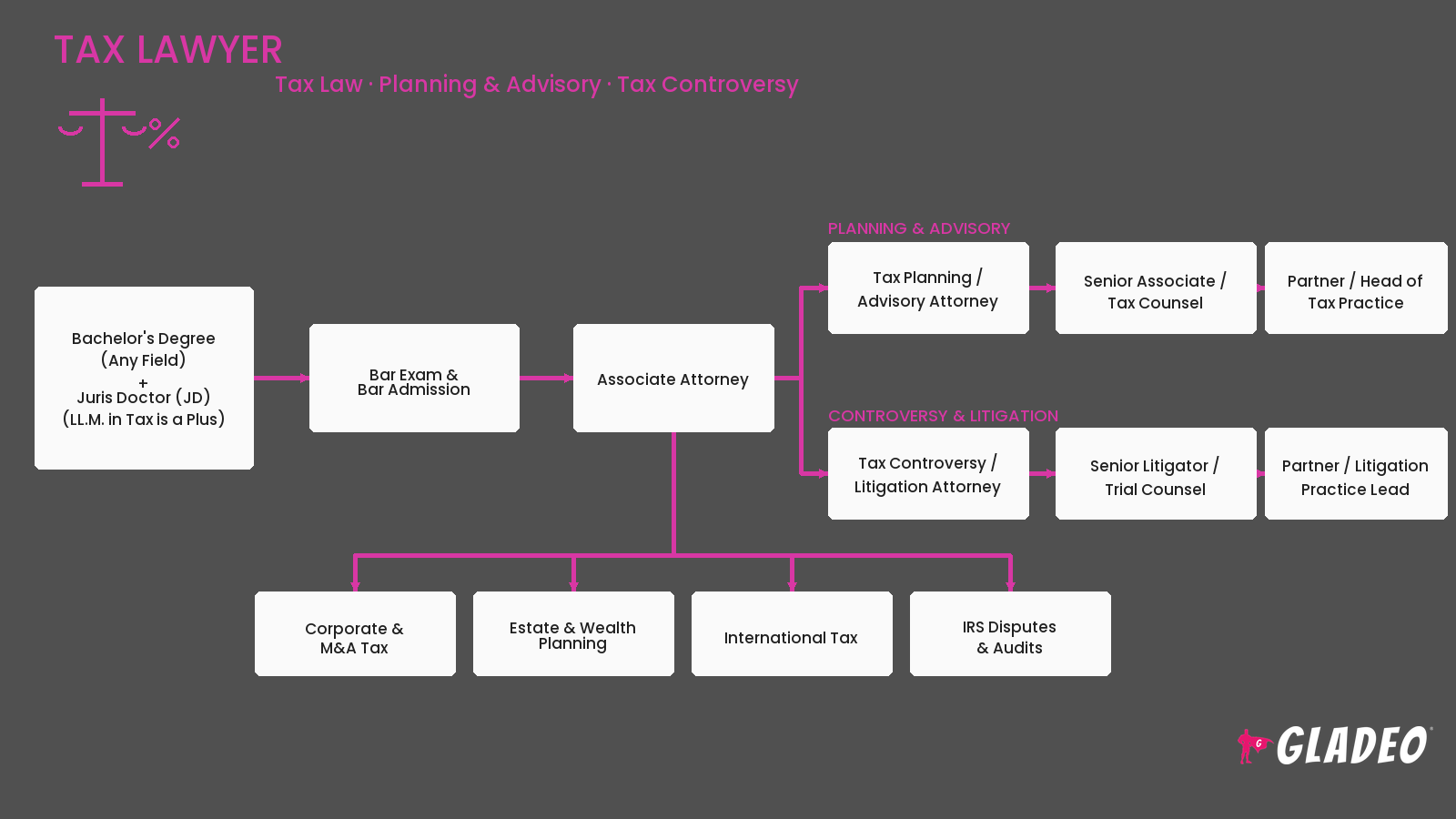
Becoming a Tax Lawyer starts with a four-year bachelor's degree. While any major can lead to law school, degrees in accounting, finance, economics, or business give future Tax Lawyers a strong foundation. Law school follows, a three-year program leading to a Juris Doctor (JD) degree, with tax law electives being essential preparation. Many Tax Lawyers go on to earn a Master of Laws (LLM) in Taxation, an additional one-year specialized degree that deepens expertise and is often preferred or required by top tax law employers. After graduation, passing the state bar exam is required to practice.
Students can take courses in relevant subjects such as:
- Federal Income Tax
- Corporate Tax
- Estate and Gift Tax
- International Tax Law
- Tax Procedure and IRS Practice
- Accounting for Lawyers
- Business Associations
- Trusts and Estates
- Legal Research and Writing
- Administrative Law
Hands-on experience is valuable throughout this path. Internships or clerkships at law firm tax practice groups, accounting firms, or the IRS Office of Chief Counsel give students real exposure to tax research and client advising. Many Tax Lawyers also pursue a Certified Public Accountant (CPA) license alongside their law degree, which strengthens their financial expertise and marketability. Continuing legal education is essential in this field, since tax law changes frequently and staying current is a professional necessity.
- Take advanced math, accounting, and economics courses
- Join a debate team or business club to build persuasive and analytical thinking skills
- Participate in a stock market simulation or personal finance program to build financial literacy
- Take an introductory accounting or bookkeeping course if your school offers one
- Research pre-law tracks and law schools with strong tax law programs and LLM options
- Practice logic and problem-solving through puzzles, chess, or coding
- Talk to tax attorneys, CPAs, or financial advisors about their day-to-day work
- Explore internships or part-time work at accounting firms or financial services companies
- Study government and civics to understand how tax legislation and the IRS work
- Build strong reading comprehension skills for working through dense regulatory text
- Consider a summer program in business, law, or finance for high schoolers
- Practice explaining complicated financial concepts clearly to someone unfamiliar with them
- Law schools with a strong tax law curriculum and LLM in Taxation option
- Faculty with real tax law practice or IRS experience
- Strong bar passage rates in the state where you plan to practice
- Opportunities for externships with the IRS Office of Chief Counsel or Tax Court
- Coursework covering corporate, estate, and international tax law
- Access to tax moot court or transactional law competitions
- Career services with connections to law firm tax groups and accounting firms
- Programs offering joint JD/LLM or JD/CPA pathways
- Strong alumni network in tax law and financial services
- Opportunities to work on real client matters through tax clinics
- Support for CPA exam preparation alongside legal studies
- Flexible scheduling if you plan to work while attending law school
- Complete an internship or clerkship at a law firm tax practice group, accounting firm, or the IRS
- Consider pursuing an LLM in Taxation to stand out in a competitive, specialized field
- Seek entry-level roles such as Associate Attorney in a tax practice group or Tax Law Clerk
- Build relationships with tax professors and practitioners through law school tax clinics
- Network through your state bar's tax law section and the American Bar Association Tax Section
- Highlight any accounting, finance, or CPA credentials prominently on your resume
- Pass the bar exam and consider pursuing CPA licensure for added credibility
- Practice explaining a mock tax strategy or audit defense clearly in interviews
- Consider starting at a large firm's tax group or an accounting firm's legal division for broad exposure
- Attend tax law conferences and CLE seminars to meet practicing attorneys
- Offer to assist senior attorneys with tax research to demonstrate analytical rigor
- Show genuine comfort with numbers and detail in interviews, since precision is everything in this field
- Take on increasingly complex corporate, estate, or international tax matters
- Build a reputation for precise research and successful IRS dispute resolution
- Pursue board certification in tax law where offered by your state bar
- Develop a trusted client base among businesses, high-net-worth individuals, or nonprofits
- Publish articles or speak at CLE events to establish expertise in a subspecialty
- Move from associate to partner, or open your own tax law practice
- Mentor junior attorneys and tax paralegals on research and client strategy
- Get involved in the American Bar Association Tax Section for leadership and networking opportunities
Websites:
- American Bar Association Section of Taxation - americanbar.org
- American College of Tax Counsel - actconline.org
- Internal Revenue Service - irs.gov
- United States Tax Court - ustaxcourt.gov
- American Institute of CPAs - aicpa.org
- Tax Foundation - taxfoundation.org
- Journal of Taxation - tax.thomsonreuters.com
- National Association of Tax Professionals - natptax.com
- Justia Tax Law Center - justia.com/tax
- American Bar Association Real Property, Trust and Estate Law Section - americanbar.org
- Tax Analysts - taxnotes.com
- Law School Admission Council (LSAC) - lsac.org
- American Taxation Association - atasection.org
- International Fiscal Association - ifa.nl
Books:
- Federal Income Taxation by Marvin A. Chirelstein and Lawrence Zelenak
- Tax Savvy for Small Business by Frederick W. Daily
- The Tax Law of Charitable Giving by Bruce R. Hopkins
- Federal Wealth Transfer Taxation by Joseph M. Dodge, Wendy C. Gerzog, and Bridget J. Crawford
- Taxation of International Transactions by Charles H. Gustafson, Robert J. Peroni, and Richard Crawford Pugh
If you find that being a Tax Lawyer isn't the right path for you, your analytical and financial skills transfer well to many related careers.
- Certified Public Accountant (CPA)
- Financial Planner or Wealth Advisor
- Corporate Tax Analyst
- Estate Planning Consultant
- IRS Revenue Agent
- Compliance Officer
- Trust Officer
- Forensic Accountant
- Tax Policy Analyst
- Investment Banking Analyst
Click here to download the infographic
Newsfeed

Featured Jobs
Online Courses and Tools