






Spotlights
Workforce Development Coordinator, Employment Specialist, Career Services Manager, Job Placement Officer, Vocational Rehabilitation Counselor, Training Program Manager, Labor Market Analyst, Adult Education Specialist, Talent Development Consultant, Workforce Consultant, Career Development Facilitator, Employment Program Director
Imagine a community where every person has the skills and opportunities to thrive in meaningful jobs, where businesses find the talent they need to grow, and where economic growth is powered by a well-prepared workforce. Workforce Development Specialists make this vision a reality by connecting people to career paths and training that open doors to better futures.
Workforce Development Specialists design, coordinate, and implement programs that help job seekers gain the skills, certifications, and experiences they need to enter or advance in the workforce. They collaborate closely with employers, educational institutions, government agencies, and community organizations to understand labor market demands and tailor services that meet those needs. Their day involves assessing client goals, organizing workshops, managing training programs, and tracking employment outcomes to ensure success for both workers and employers.
Using data analysis tools, career assessment software, and management platforms, Workforce Development Specialists blend people skills with strategic planning to align job training efforts with real economic opportunities. Their work bridges gaps between education and employment, helping individuals overcome barriers to employment and contributing to stronger economies and healthier communities.
- Helping individuals overcome challenges and achieve career goals brings a deep sense of personal fulfillment.
- Seeing the positive impact of connecting employers with skilled workers fuels motivation and pride.
- Playing a key role in community and economic development creates a meaningful contribution beyond the individual level.
- Continuous learning about labor market trends and workforce strategies keeps the work dynamic and intellectually engaging.
Working Schedule
Workforce Development Specialists typically work full-time during regular business hours, but the schedule can vary depending on program needs. Some may work evenings or weekends to accommodate client availability or special events. The role can be found in government agencies, non-profits, or educational settings, with many specialists balancing office work and field visits to employers or training sites. Deadlines and funding cycles sometimes create periods of intense activity, but collaboration and community focus provide rewarding work environments.
Typical Duties
- Assess client skills, interests, and employment barriers through interviews and standardized tools.
- Develop individualized career plans and recommend suitable training or education programs.
- Coordinate and deliver job readiness workshops, including resume writing and interview skills.
- Build and maintain relationships with local employers to identify job openings and skill demands.
- Manage partnerships with educational institutions and training providers to align curricula with labor market needs.
- Track participant progress and collect data on employment outcomes for program evaluation.
- Advise clients on labor market trends and emerging career opportunities.
- Assist clients with job search strategies, including networking and application assistance.
- Develop grant proposals and manage program budgets to secure funding and resources.
- Advocate for clients facing barriers such as disabilities, language differences, or lack of experience.
- Organize job fairs and employer engagement events to connect clients with opportunities.
- Provide coaching and support to help clients maintain employment and advance their careers.
Additional Responsibilities
- Stay informed about changes in labor laws and workforce regulations.
- Collaborate with social service agencies to address clients’ holistic needs.
- Train and supervise junior staff or volunteers involved in workforce programs.
- Prepare reports for funders and stakeholders to demonstrate program impact.
- Participate in community planning initiatives to improve local employment ecosystems.
- Develop marketing materials to promote workforce programs to potential clients and partners.
- Engage in professional development to stay current with best practices in workforce development.
- Support policy advocacy efforts to improve workforce training and employment services.
In the morning, a Workforce Development Specialist might review client files and data to prepare for scheduled counseling sessions, ensuring they understand each individual’s background and goals. They also check in with partner organizations to coordinate upcoming workshops and training schedules.
Midday often involves meeting with clients one-on-one or in group settings to provide career counseling, skill assessments, and job search support. The specialist may also visit local businesses to discuss hiring needs or attend a planning meeting with educators to align training programs with employer demands.
In the afternoon and early evening, the specialist follows up on job placements, updates program databases, and prepares reports on client progress. They might attend a community event or job fair to network with employers and promote services, wrapping up the day by planning next steps for clients and program improvements.
Soft Skills
- Empathy to understand client challenges and build trust.
- Strong communication skills for counseling and collaboration.
- Problem-solving mindset to develop creative employment solutions.
- Organizational skills to manage multiple clients and programs.
- Adaptability to respond to changing labor market conditions.
- Patience and resilience when working with clients facing barriers.
- Networking ability to build partnerships with employers and agencies.
- Cultural competence to serve diverse populations respectfully.
- Motivation to inspire clients toward career success.
- Attention to detail for accurate record-keeping and reporting.
- Teamwork to collaborate effectively with colleagues and partners.
- Conflict resolution skills to navigate sensitive situations.
Technical Skills
- Proficiency with career assessment and case management software.
- Data analysis skills to interpret employment trends and program outcomes.
- Familiarity with labor market information systems.
- Experience using Microsoft Office suite (Word, Excel, PowerPoint).
- Knowledge of social media and digital marketing tools for outreach.
- Grant writing and budget management capabilities.
- Understanding of adult learning principles and training methodologies.
- Basic knowledge of labor laws and employment regulations.
- Ability to create presentations and training materials.
- Use of virtual meeting platforms for remote counseling and workshops.
- Career Services Specialist: Focuses on guiding individuals through career exploration and job placement.
- Employer Relations Coordinator: Builds and maintains partnerships with businesses to match job seekers with openings.
- Training Program Manager: Designs and oversees workforce training initiatives and curriculums.
- Youth Workforce Specialist: Tailors programs specifically for young adults entering the job market.
- Veterans Employment Specialist: Provides specialized support to military veterans transitioning to civilian careers.
- Disability Employment Specialist: Works with individuals with disabilities to find suitable employment opportunities.
- Adult Education Coordinator: Integrates basic education with job skills training for adult learners.
- Economic Development Workforce Analyst: Studies labor market data to inform workforce strategies and policies.
- Government workforce development agencies
- Community-based non-profit organizations
- Public and private educational institutions
- Workforce investment boards
- Chambers of commerce and business associations
- Vocational rehabilitation centers
- Labor unions and trade associations
- Economic development corporations
- Social service agencies
- Private career and staffing firms
- Correctional institution employment programs
- Healthcare workforce initiatives
Workforce Development Specialists often face the challenge of balancing the needs of diverse clients while meeting program goals and funding requirements. The role can involve emotional demands as they support individuals dealing with unemployment, underemployment, or other barriers to work. Deadlines for grant reporting and program deliverables add pressure to ensure timely and measurable results.
While most work is during typical office hours, specialists frequently extend their availability to evenings or weekends to accommodate clients’ schedules or community events. The job can require travel to meet with employers, training sites, or partner agencies, and managing multiple projects simultaneously is common.
The role demands patience, persistence, and strong interpersonal skills, as success often depends on building trust and motivating clients over time. Workforce Development Specialists must be flexible and proactive, adapting to changing economic conditions, policy shifts, and funding landscapes while maintaining focus on their mission to connect people with meaningful work.
- Increasing use of digital platforms and virtual services for career counseling and job training.
- Growing emphasis on equity and inclusion to serve underrepresented populations.
- Integration of data analytics to better match skills with employer needs.
- Expansion of partnerships between employers, educators, and workforce programs.
- Focus on upskilling and reskilling workers for technology-driven industries.
- Greater attention to mental health and holistic support services for job seekers.
- Development of stackable credentials and micro-credentials for flexible learning.
- Use of artificial intelligence to streamline job matching and career planning.
- Shift towards demand-driven training based on real-time labor market information.
- Policies promoting workforce development as a tool for economic recovery and growth.
Many Workforce Development Specialists discovered their passion for helping others and organizing activities at a young age, often volunteering in community groups or school clubs focused on leadership and service. They enjoyed roles where they could guide peers, solve problems, and coordinate events that made a difference.
Early interests often included understanding how businesses and communities work, alongside a desire to support people in overcoming challenges. Skills like active listening, teamwork, and empathy were natural strengths, laying the foundation for a career dedicated to connecting people with opportunities.
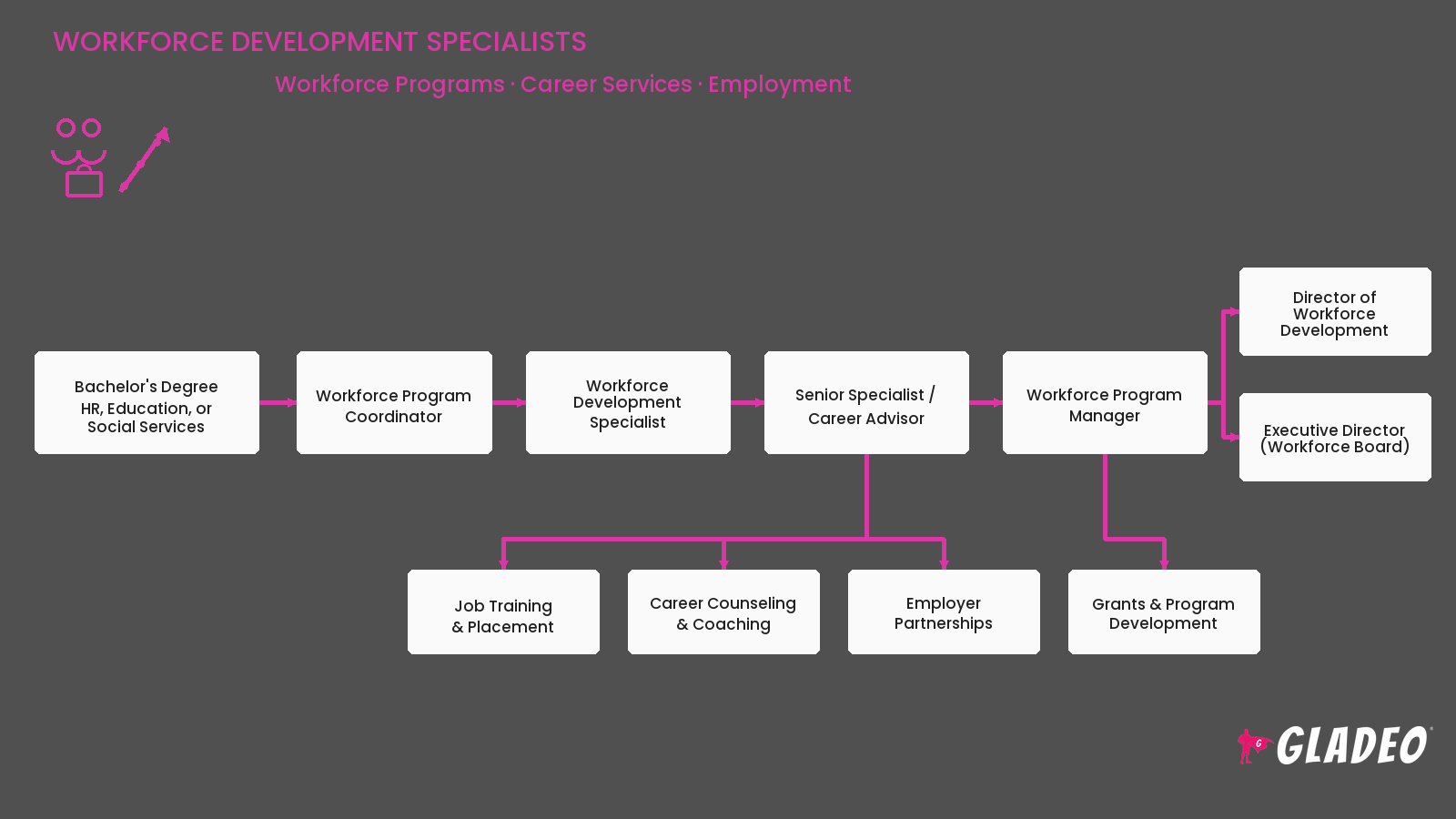
Becoming a Workforce Development Specialist typically involves a bachelor’s degree in fields like human resources, education, social work, public administration, or business. Coursework and training focus on counseling, program management, labor economics, and community development. Many professionals also pursue certifications or graduate studies to deepen their expertise.
Students can take courses in relevant subjects such as:
- Career Counseling and Guidance
- Adult Learning and Education
- Human Resource Management
- Public Policy and Administration
- Labor Economics
- Program Planning and Evaluation
- Community Development
- Grant Writing and Fundraising
- Data Analysis for Social Programs
- Communication and Conflict Resolution
Hands-on experience through internships, volunteer work, or entry-level positions in workforce programs is crucial to building practical skills and professional networks. Developing a strong portfolio of successes and continuous learning about labor market trends will help aspiring specialists excel in this dynamic field.
- Take classes in social studies, economics, psychology, and communication.
- Participate in community service and volunteer projects focused on helping others.
- Join clubs or organizations that focus on leadership, public speaking, or peer counseling.
- Develop strong writing and computer skills, including proficiency in Microsoft Office.
- Attend career fairs and workforce development events to learn about the field.
- Seek internships or summer jobs in community organizations or government offices.
- Learn about local labor markets and economic trends through research projects.
- Practice problem-solving and teamwork through group activities and projects.
- Explore online courses or workshops on counseling and program management.
- Build relationships with mentors in education, social services, or business sectors.
- Look for programs with strong connections to local employers and workforce boards.
- Choose schools that offer internships or cooperative education opportunities.
- Prioritize curricula that include both theoretical knowledge and practical application.
- Find programs with faculty experienced in workforce development or related fields.
- Ensure access to career counseling and professional development resources.
- Consider certifications like Certified Workforce Development Professional (CWDP).
- Select programs that emphasize data analysis and technology skills.
- Seek opportunities to work with diverse populations and in community settings.
- Evaluate program success rates in job placement and graduate outcomes.
- Look for supportive learning environments with small class sizes and personalized attention.
- Check for availability of financial aid and scholarships.
- Explore online or hybrid program options for flexibility.
- Volunteer or intern at local workforce development agencies or community organizations.
- Assist with job fairs, workshops, or training sessions to gain event coordination experience.
- Support client intake and assessment processes to learn counseling basics.
- Help with data entry and tracking participant outcomes to understand program metrics.
- Shadow experienced Workforce Development Specialists to observe counseling and employer engagement.
- Develop outreach materials and social media content to build communication skills.
- Participate in grant writing or reporting to learn about program funding.
- Network with employers and educational institutions to understand partnership building.
- Attend professional workshops and training to build industry knowledge.
- Take on administrative tasks to become familiar with program operations.
- Join professional associations for workforce development to connect with mentors.
- Seek part-time roles in related fields, such as human resources or social services.
- Gain certifications in workforce development or career counseling to enhance credentials.
- Master data analysis tools to improve program design and outcomes.
- Build a strong professional network with employers, educators, and policymakers.
- Lead specialized programs targeting youth, veterans, or underserved groups to gain expertise.
- Develop leadership skills to transition into supervisory or management roles.
- Stay current on labor market trends and emerging workforce technologies.
- Contribute to policy development or advocacy efforts to influence the field.
- Pursue advanced degrees in public administration, education, or social work for career advancement.
Websites:
- National Association of Workforce Development Professionals (NAWDP) - nawdp.org
- WorkforceGPS - workforcegps.org
- Society for Human Resource Management (SHRM) - shrm.org
- U.S. Department of Labor Employment and Training Administration - dol.gov/agencies/eta
- National Skills Coalition - nationalskillscoalition.org
- Association for Talent Development (ATD) - td.org
- International Economic Development Council (IEDC) - iedconline.org
- Jobs for the Future - jobsforfuture.org
- Council for Adult and Experiential Learning (CAEL) - cael.org
- National Career Development Association (NCDA) - ncda.org
- American Association of Community Colleges (AACC) - aacc.nche.edu
- LinkedIn Workforce Development Groups
- EdTech and Workforce Innovation Forums
Books:
- Workforce Development Systems: Promoting Employment in the Changing Economy by David G. White
- Career Development Interventions by Spencer G. Niles and JoAnn Harris-Bowlsbey
- The Adult Learner: The Definitive Classic in Adult Education and Human Resource Development by Malcolm S. Knowles
- Building Workforce Development Systems: A Guide to Leading Change by David G. White
- Workforce Development: Strategies and Practices by Mary Beth Mazur
If the path of a Workforce Development Specialist isn’t the perfect fit, there are many related careers that also focus on helping people succeed and supporting economic growth.
- Human Resources Specialist
- Career Counselor
- Social Worker
- Training and Development Manager
- Employment Coordinator
- Vocational Rehabilitation Counselor
- Economic Development Specialist
- Community Outreach Coordinator
- Education Program Administrator
- Talent Acquisition Specialist
Click here to download the infographic
Newsfeed

Featured Jobs
Online Courses and Tools